



What Is a Normally De-Energized Electromagnet? Principles, Structure, and Advantages
Electromagnets are among the important actuators in industry, material clamping, safety protection, and precision equipment. In most traditional cases, electromagnets operate in a simple manner. Energize to attract, de-energize to release. Even though effective in many cases, there are notable disadvantages of these in certain conditions, i.e., high power consumption, poor performance during power interruption, and safety hazards.
There are other operating principles of the normally de-energized electromagnets. They perform differently from the normal ones, and that makes them the best choice for industrial applications. However, many engineers are still wondering, "What is a normally de-energized electromagnet, and what makes it different from the ordinary electromagnet?" This article provides a comprehensive overview of its definition, internal construction, operating principle, benefits, and applications.
What Is a Normally De-energized Electromagnet?
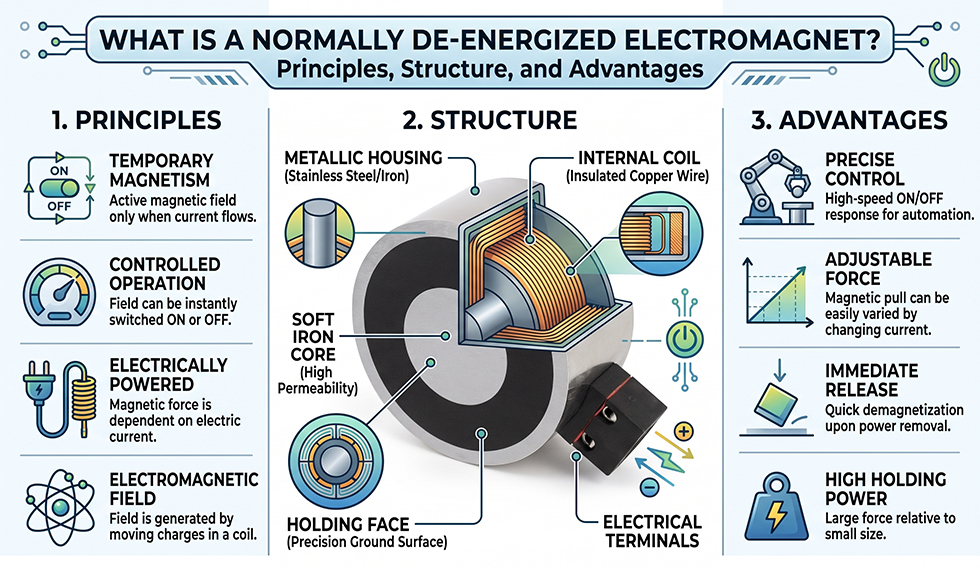
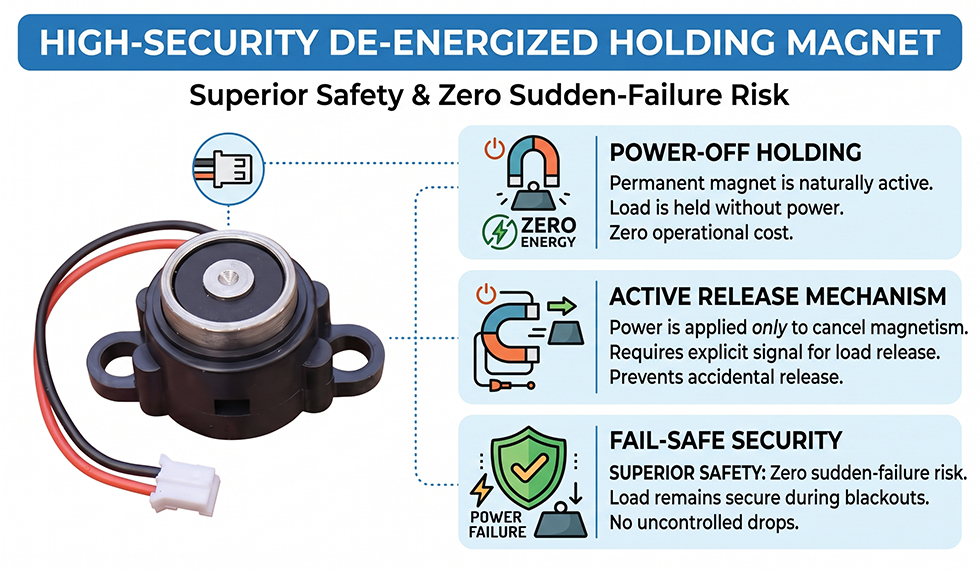
Electromagnet: The magnetic part that is normally de-energized is magnetized while the power is off and demagnetized when the power is on. It is also called a power-off holding electromagnet or permanent magnetic chuck. It differs from the normal model by the presence of the internal permanent magnets creating a stable holding force without electricity. All that is required is power to release the workpiece.
This particular mode is perfect for applications requiring long-term clamping with instant release, therefore eliminating the continuous energy drain and sudden workpiece drop in case of failures of traditional electromagnets.
Parts and Internal Construction
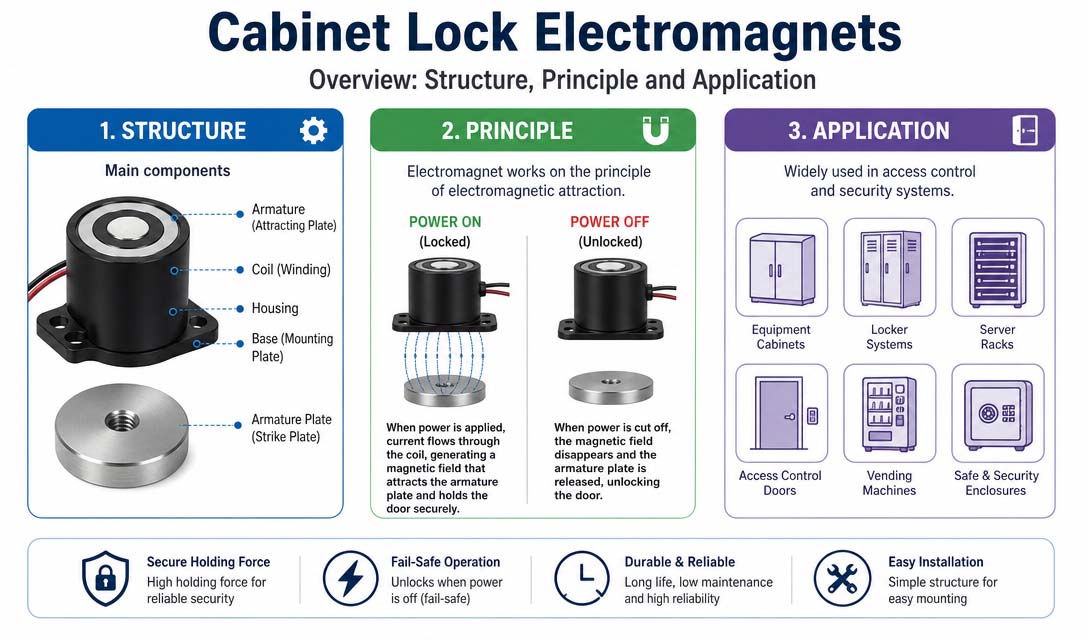
High-precision construction is the key factor for the reliable operation of normally de-energized electromagnets. Main parts include:
Yoke iron—standardizes and guides the magnetic circuit, reduces losses, and increases efficiency.
Electromagnetic coil—it is the magnetic control device. It creates the reverse field once energizecancelsls out the force of the permanent magnet.
Permanent magnet—it is the main power source, affecting directly the holding force, stability, and off-state lifetime.
Epoxy resin adhesive—seals and insulates, protecting the device from water, dust, and corrosion, and durability in harsh industrial conditions.
Each part operates independently and in cooperation, providing consistent and long-term performance.
Operating Principle: No Permanent Demagnetization, Only Magnetic Field Cancellation
One of the common misconceptions about power-on demagnetization is that it permanently erases the magnetic properties of the permanent magnet. The actual operating principle is based on the temporary cancellation, an advanced technology.
In the normal power-off state, the permanent magnet inside creates a stable magnetic field through the yoke iron, forming the magnetic field loop. The surface of the electromagnet becomes strongly and permanently attractive. The ferromagnetic workpieces are retained by the permanent magnet even without a power supply.
The workpiece is released by applying the rated current momentarily to the electromagnetic coil. As a result, the reverse magnetic field appears, which cancels out the force of the permanent magnet. The attractive force decreases dramatically, and the workpiece release is smooth if the attraction force is lower than the workpiece weight or external force.
Importantly, this is the temporary cancellation, but not the permanent demagnetization. When the power is switched off, the reverse field disappears instantly, and the magnet returns to its maximum magnetic strength. No degradation and attenuation take place after cycles.
Advantages Compared to Traditional Electromagnets
There are several obvious advantages of normally de-energized electromagnets over the traditional ones:
Extreme energy saving—Most industrial clamping requires long-term holding. Traditional electromagnets operate all the time and waste energy significantly. Normally the de-energized type requires only a temporary power supply for the release, saving 99% of the cycle energy.
High safety and absence of unexpected failures—traditional electromagnets stop retaining the suction during power failures and circuit anomalies, risking dropping the workpieces, equipment damage, production stoppage, and injuries of personnel. The holding force of normally de-energized electromagnets is independent of the power supply and retains stability during any failure, therefore eliminating accidents due to power anomalies—ideal for high-altitude operation, heavy-load clamping, and precision equipment mounting.
High lifetime, high stability—Conventional electromagnets often fail due to continuous energization heating up the coils, accelerating the aging and burnout. In normally de-energized models, the coils are energized for a moment and generate very low heat. The built-in permanent magnets provide constant performance for years. Workpieces are retained reliably for long periods without maintenance. In addition, the sealed design allows you to get the good dustproof, moisture-proof, and anti-interference capabilities, so these electromagnets are suitable for challenging environments such as machine tool machining, warehouse sorting, automatic production lines, and so on.
Applications
Due to the above-mentioned benefits, the de-energized electromagnets are widely applied in the industries:
Mechanical processing—as the fixture of the machine tool to retain steel workpieces and ensure the machining accuracy.
Automated logistics—for the precise material handling, sorting, and loading/unloading.
Safety protection—in magnetic door locks and equipment safety latches to ensure stability in case of power outages.
Fixing and positioning of the molds, heavy equipment, and robotic tooling systems—where the fail-safe and reliable clamping are required.
Tailored Solutions for Various Requirements
The dimensions, off-state holding force, energizing frequency, speed, and environmental conditions differ for different industries. To satisfy these requirements, we provide a full range of customized solutions for the normally de-energized electromagnets. You can customize the core parameters like mounting dimensions, rated holding force, operating frequency, and protection level according to your needs.
Please share with us your procurement or customization requirements with the detailed parameters, such as installation space limitations, off-state magnetic force requirements, working frequency, environmental conditions, and so on. Our professional team will provide you with accurate model selection and customization and deliver high-stability and long-service-life products perfectly matching your industrial production requirements.
Frequently Asked Questions (FAQs)
Q1: Can a normally de-energized electromagnet lose its magnetism over time?
No, sir. The permanent magnets in these devices are made from the highly stable magnetic materials (neodymium or ferrite) and retain their magnetic properties for many years. The power-on demagnetization is a temporary cancellation of the field, not a permanent loss. Provided these electromagnets are used as intended, the rated holding force remains constant throughout the product's lifetime.
Q2: What if I continuously energize the coil?
The continuous energizing can be problematic. The coil of these electromagnets is designed to operate momentarily (for a few seconds). Continuous energizing leads to the coil overheating, insulation breakdown, and malfunction. The power should be supplied only for releasing during normal operation.
Q3. Can normally de-energized electromagnets be used in outdoor or wet locations?
Sure, if they are sealed properly. Most of the devices are enclosed in the epoxy resin, providing IP65 or higher protection, resistant to water, dust, and humidity. However, always check the particular ingress protection (IP) rating before using it in your environment.
Q4: How do I select the proper holding force for my application?
The holding force required depends on the workpiece weight, the orientation (horizontal, vertical, or overhead), and the dynamic forces (vibration, acceleration, or impacts). Generally, it is recommended to choose the model with a rated holding force 2-3 times the static weight of the workpiece.
Q5: Can these electromagnets be used in a high-temperature environment?
The materials of the permanent magnets have limited temperature ranges of operation. For standard neodymium magnets, the typical maximum operating temperatures range from 80°C to 120°C. Samarium-cobalt or alnico versions can withstand higher temperatures. Always specify your ambient temperature range during customization to choose the proper material.
Q6: Can the holding force be adjusted?
The holding force depends on the strength of the permanent magnet and magnetic circuit design. However, some customized designs can provide the adjustable holding force by varying the coil current or using the multi-stage magnetic circuit design. Please contact our engineering team to discuss your particular needs.
Q7: What maintenance is required for these electromagnets?
The maintenance of these devices is minimal. Regularly inspect the surface for the ferrous dust and physical damage. Keep the surface clean for the full magnetic contact. In comparison with the conventional electromagnets, it does not require maintenance because it does not have brushes, moving parts, or coil burnout problems in normal operation.
Q8: Can these electromagnets be repaired in case of coil failure?
The coil and permanent magnet are generally completely potted in the epoxy resin; therefore, repair of these components is impossible. In most cases, the entire device is replaced. However, as compared to the traditional continuously energized design, normally de-energized electromagnets rarely have coil failure due to the momentary operation of the coil.